
On Friday 25th July the Guernsey Financial Services Commission published its long-awaited response to last December’s consultation, Supporting Growth with Digital Finance, alongside a new Guidance Note on Tokenisation. Together they run to nearly fifty pages of regulatory prose, which is either a very good sign or a very good cure for insomnia, depending on your appetite for this sort of thing.
I read both papers cover to cover, and I think they’re worth a proper look, not just for what they say, but for what they signal about where Guernsey is positioning itself, and what that means for a business like TVVIN.
The headline: Guernsey isn’t chasing hype, it’s clearing a path
The most striking thing about this feedback paper is how little drama is in it. There’s no grand reinvention of the regulatory framework, no rush to build bespoke crypto rules from scratch. Instead, the Commission’s basic message is: our existing legal and regulatory architecture already works for digital finance, so let’s remove the friction that’s stopping people using it properly.
That’s a genuinely sensible position, and it’s the right one for a jurisdiction that has spent decades building a reputation on being boring in all the ways that matter, i.e. legal certainty, prudential rigour, a functioning AML/CFT regime, while being flexible in the ways that don’t. Guernsey isn’t trying to out-innovate Dubai or out-market Switzerland. It’s trying to be the place where serious digital finance business gets done without anyone having to explain to their board why the regulator is a risk.
A few concrete moves stood out to me:
- Removing dual licensing. Firms already licensed under the Protection of Investors Law or the Insurance Business Law will be able to hold, trade or invest in virtual assets without needing a second VASP licence bolted on top. That’s a meaningful reduction in regulatory drag for anyone building at the intersection of traditional finance and digital assets — which, increasingly, is everyone.
- Retail access to VASP services. The old rule limiting licensed virtual asset activity to wholesale and institutional counterparties is being scrapped. Guernsey firms will be able to serve retail customers directly, subject to the same conduct standards that already apply to every other regulated business. This is a bigger deal than it sounds — it’s the Commission explicitly deciding that digital assets don’t deserve a permanent asterisk next to “public markets.”
- Public blockchains for fund tokenisation. Previously, fund tokenisation had to sit on private, permissioned ledgers. That restriction has now gone. It’s a small technical change with a large practical consequence: it opens the door to genuinely interoperable, composable fund structures rather than walled gardens.
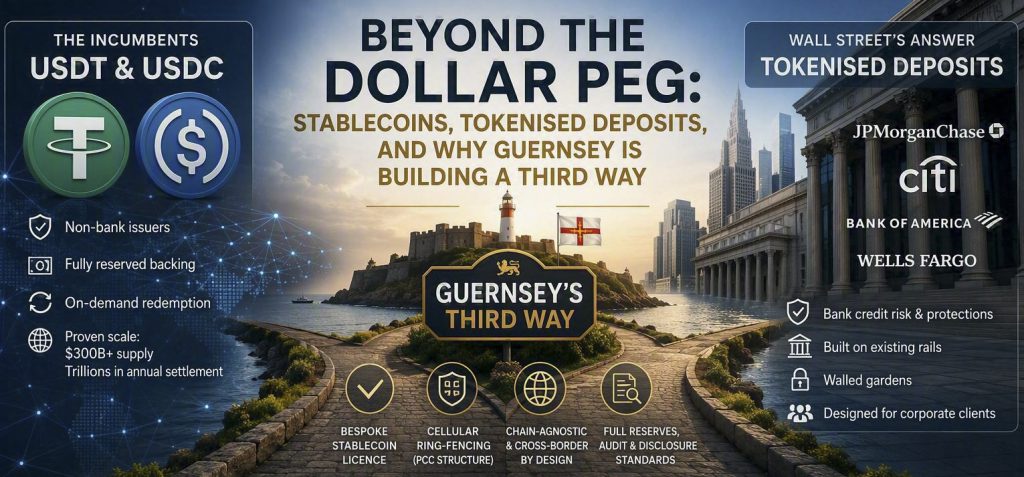
- A sensible, internationally aligned approach to bank capital treatment. Perhaps the most underrated part of the whole paper. Guernsey is proposing to treat soundly backed, Guernsey-regulated stablecoins in line with their underlying reserve assets for bank capital purposes — broadly the Basel Committee’s “Group 1a” treatment — rather than lumping them in with unbacked cryptoassets and their punitive 1250% risk weighting. That’s the difference between a stablecoin being a curiosity on a bank’s balance sheet and being genuinely usable financial infrastructure.
Where TVVIN sits in all this
I’ll declare the obvious interest: I co-founded TVVIN, a GFSC licence-pending stablecoin issuance platform structured as a Protected Cell Company here in Guernsey. So I’m reading this feedback paper less as an observer and more as someone trying to work out what our next eighteen months look like.
The honest answer is: mostly reassuring, with one open question still hanging.
The banking section is the clearest positive signal. A Guernsey-regulated payment stablecoin issuer (which is what TVVIN is seeking a licence to become) is expected to sit within Group 1a of the Basel classification, meaning banks holding our stablecoin on balance sheet can look through to the underlying reserve assets rather than treating it as a punitive, high-risk exposure. That’s not a cosmetic point. It’s the regulatory plumbing that determines whether institutional treasuries and banking partners can actually hold and use a Guernsey stablecoin at scale, rather than merely admiring it from a distance. For a business built on the premise that stablecoins should be genuine payment infrastructure rather than a trading instrument, that’s the right foundation to be building on.
The confirmation that existing PoI and insurance licensees can now deal in virtual assets without a second VASP licence is also a quiet but useful piece of market-building. It means more of the traditional finance ecosystem in Guernsey can integrate with digital asset infrastructure like ours without the friction of dual authorisation. That’s good for adoption, and adoption is the whole game.
The one deliberate gap in this paper is stablecoins themselves. The Commission has explicitly held back its stablecoin-specific feedback and rules for now, and the accompanying Tokenisation Guidance Note goes out of its way to state, in its opening paragraph, that it doesn’t apply to stablecoins at all. So, the framework that will actually govern reserve composition, redemption rights and issuer obligations for businesses like ours is still to come. Everything published this week is the scaffolding around that framework, not the framework itself.
I don’t read anything into the stablecoin rules not arriving yet as anything to worry about, indeed, the tone of everything around it, the banking treatment, the “same activity, same risk, same regulatory outcome” principle repeated throughout, the explicit statement that this reflects “strong industry support for a clear and credible approach”, suggests the direction of travel is settled, and the anticipated publication is about getting the detail right rather than deciding whether to proceed at all. Guernsey doesn’t move fast for the sake of moving fast. It moves once, and it moves deliberately.
The wider point
What I take from this, stepping back from TVVIN specifically, is that Guernsey has quietly become one of the most coherent places in the world to build serious digital finance infrastructure. Not the loudest. Not the one with the flashiest sandbox marketing. But a jurisdiction that is willing to say, in fifty pages of careful prose, “our law already works, here’s how, and here’s where we’ll tidy it up” and then actually get on and do the tidying.
For those of us building here, that’s worth more than a press release.
Summer 2026 is an exciting time!