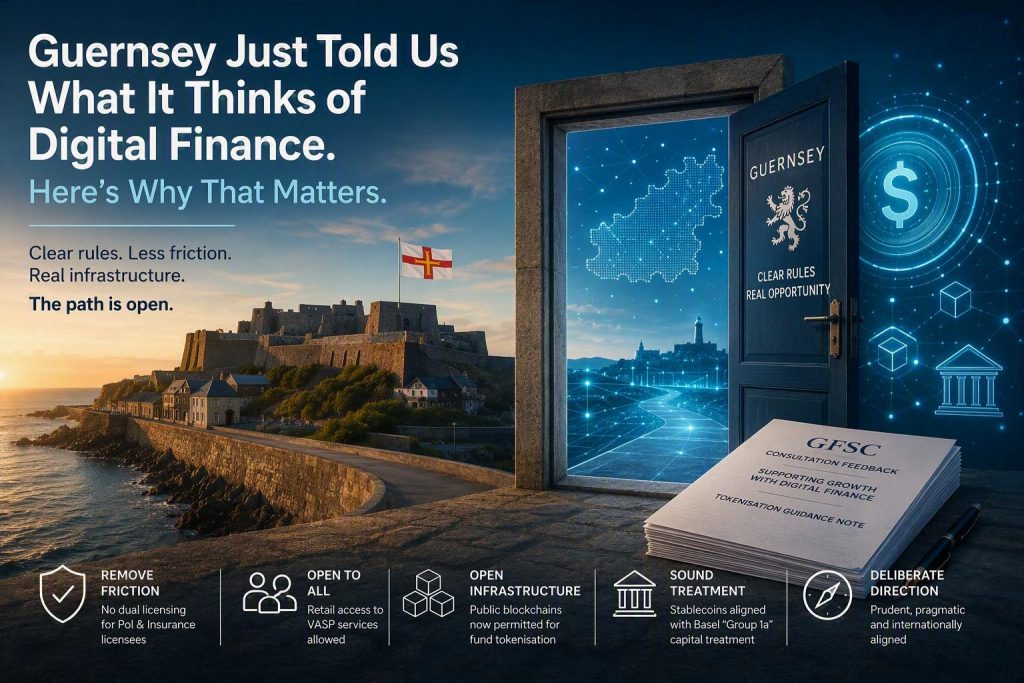
Guernsey Just Told Us What It Thinks of Digital Finance. Here’s Why That Matters.

On Friday 25th July the Guernsey Financial Services Commission published its long-awaited response to last December’s consultation, Supporting Growth with Digital Finance, alongside a new Guidance Note on Tokenisation. Together they run to nearly fifty pages of regulatory prose, which is either a very good sign or a very good cure for insomnia, depending on your appetite for this sort of thing.

I read both papers cover to cover, and I think they’re worth a proper look, not just for what they say, but for what they signal about where Guernsey is positioning itself, and what that means for a business like TVVIN.

The headline: Guernsey isn’t chasing hype, it’s clearing a path

The most striking thing about this feedback paper is how little drama is in it. There’s no grand reinvention of the regulatory framework, no rush to build bespoke crypto rules from scratch. Instead, the Commission’s basic message is: our existing legal and regulatory architecture already works for digital finance, so let’s remove the friction that’s stopping people using it properly.

That’s a genuinely sensible position, and it’s the right one for a jurisdiction that has spent decades building a reputation on being boring in all the ways that matter, i.e. legal certainty, prudential rigour, a functioning AML/CFT regime, while being flexible in the ways that don’t. Guernsey isn’t trying to out-innovate Dubai or out-market Switzerland. It’s trying to be the place where serious digital finance business gets done without anyone having to explain to their board why the regulator is a risk.

A few concrete moves stood out to me:

  • Removing dual licensing. Firms already licensed under the Protection of Investors Law or the Insurance Business Law will be able to hold, trade or invest in virtual assets without needing a second VASP licence bolted on top. That’s a meaningful reduction in regulatory drag for anyone building at the intersection of traditional finance and digital assets — which, increasingly, is everyone.
  • Retail access to VASP services. The old rule limiting licensed virtual asset activity to wholesale and institutional counterparties is being scrapped. Guernsey firms will be able to serve retail customers directly, subject to the same conduct standards that already apply to every other regulated business. This is a bigger deal than it sounds — it’s the Commission explicitly deciding that digital assets don’t deserve a permanent asterisk next to “public markets.”
  • Public blockchains for fund tokenisation. Previously, fund tokenisation had to sit on private, permissioned ledgers. That restriction has now gone. It’s a small technical change with a large practical consequence: it opens the door to genuinely interoperable, composable fund structures rather than walled gardens.
  • A sensible, internationally aligned approach to bank capital treatment. Perhaps the most underrated part of the whole paper. Guernsey is proposing to treat soundly backed, Guernsey-regulated stablecoins in line with their underlying reserve assets for bank capital purposes — broadly the Basel Committee’s “Group 1a” treatment — rather than lumping them in with unbacked cryptoassets and their punitive 1250% risk weighting. That’s the difference between a stablecoin being a curiosity on a bank’s balance sheet and being genuinely usable financial infrastructure.

Where TVVIN sits in all this

I’ll declare the obvious interest: I co-founded TVVIN, a GFSC licence-pending stablecoin issuance platform structured as a Protected Cell Company here in Guernsey. So I’m reading this feedback paper less as an observer and more as someone trying to work out what our next eighteen months look like.

The honest answer is: mostly reassuring, with one open question still hanging.

The banking section is the clearest positive signal. A Guernsey-regulated payment stablecoin issuer (which is what TVVIN is seeking a licence to become) is expected to sit within Group 1a of the Basel classification, meaning banks holding our stablecoin on balance sheet can look through to the underlying reserve assets rather than treating it as a punitive, high-risk exposure. That’s not a cosmetic point. It’s the regulatory plumbing that determines whether institutional treasuries and banking partners can actually hold and use a Guernsey stablecoin at scale, rather than merely admiring it from a distance. For a business built on the premise that stablecoins should be genuine payment infrastructure rather than a trading instrument, that’s the right foundation to be building on.

The confirmation that existing PoI and insurance licensees can now deal in virtual assets without a second VASP licence is also a quiet but useful piece of market-building. It means more of the traditional finance ecosystem in Guernsey can integrate with digital asset infrastructure like ours without the friction of dual authorisation. That’s good for adoption, and adoption is the whole game.

The one deliberate gap in this paper is stablecoins themselves. The Commission has explicitly held back its stablecoin-specific feedback and rules for now, and the accompanying Tokenisation Guidance Note goes out of its way to state, in its opening paragraph, that it doesn’t apply to stablecoins at all. So, the framework that will actually govern reserve composition, redemption rights and issuer obligations for businesses like ours is still to come. Everything published this week is the scaffolding around that framework, not the framework itself.

I don’t read anything into the stablecoin rules not arriving yet as anything to worry about, indeed, the tone of everything around it, the banking treatment, the “same activity, same risk, same regulatory outcome” principle repeated throughout, the explicit statement that this reflects “strong industry support for a clear and credible approach”, suggests the direction of travel is settled, and the anticipated publication is about getting the detail right rather than deciding whether to proceed at all. Guernsey doesn’t move fast for the sake of moving fast. It moves once, and it moves deliberately.

The wider point

What I take from this, stepping back from TVVIN specifically, is that Guernsey has quietly become one of the most coherent places in the world to build serious digital finance infrastructure. Not the loudest. Not the one with the flashiest sandbox marketing. But a jurisdiction that is willing to say, in fifty pages of careful prose, “our law already works, here’s how, and here’s where we’ll tidy it up” and then actually get on and do the tidying.

For those of us building here, that’s worth more than a press release.

Summer 2026 is an exciting time!
Beyond the Dollar Peg

Stablecoins, Tokenised Deposits, and Why Guernsey Is Building a Third Way

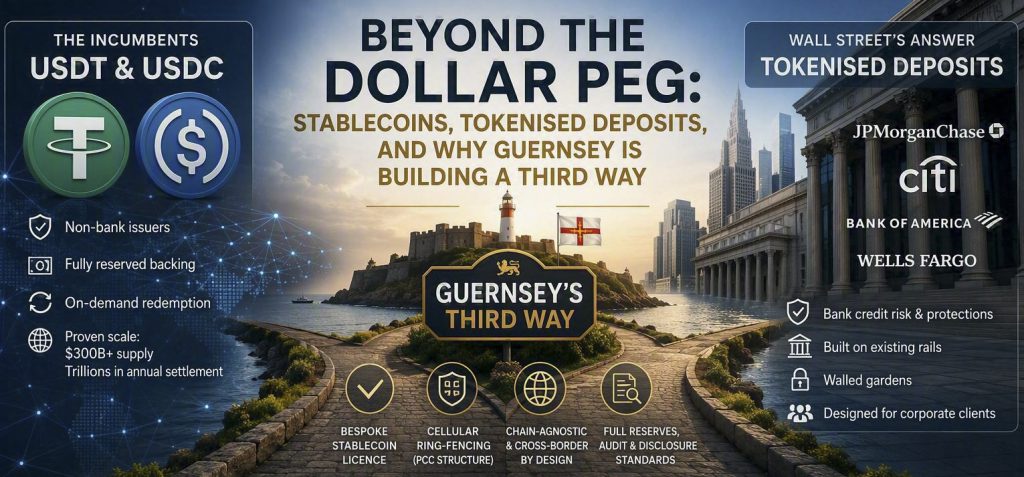
Stablecoins have quietly become one of the largest pieces of financial infrastructure to emerge from crypto markets, with total supply running somewhere north of $300 billion and two issuers, Tether’s USDT and Circle’s USDC, controlling roughly 85% of it between them. That dominance is now being challenged from two directions at once: Wall Street’s largest banks are building their own tokenised alternative, and a small number of well-regulated jurisdictions are proposing a structure that borrows the best of both worlds. Guernsey, and TVVIN specifically, sit in that third category, and the differences matter more than they might first appear.

The incumbents: USDT and USDC

Today’s stablecoin market is a study in concentration. USDT alone accounts for close to 60% of global supply, with USDC a distant second at around a quarter of the market, according to on-chain data aggregated by DefiLlama. Both are issued by non-bank companies that hold cash and short-dated government securities against every token in circulation, publish periodic attestations of those reserves, and allow holders to redeem on demand.
That model has proven itself at scale. Circulating supply has roughly doubled since 2024, and stablecoins now settle trillions of dollars a year in crypto trading, DeFi collateral and, increasingly, cross-border payments and remittances. Regulation is finally catching up: the US GENIUS Act’s implementation rules take full effect this month, requiring dollar stablecoin issuers to hold fully reserved, regularly audited backing, while the EU’s MiCA regime already classifies stablecoins as e-money or asset-referenced tokens issued only by authorised entities.
But the structural characteristics that built USDT and USDC’s scale are also their limitation. They are, ultimately, IOUs from a single non-bank company. Holders take on that issuer’s counterparty and reserve-management risk rather than a bank’s, and Tether’s continuing absence of a full independent audit being a frequently cited example, transparency standards still vary considerably between issuers.

Wall Street’s answer: tokenised deposits

The most direct competitive response has come from the banks themselves. In June, JPMorgan Chase, Citigroup, Bank of America and Wells Fargo confirmed plans, reported first by the Wall Street Journal, to build a shared tokenised deposit network through The Clearing House, the payments utility the banks jointly own, targeting a launch in the first half of 2027. Individually, several of them are already live: JPMorgan’s JPM Coin has operated on Coinbase’s Base network for institutional clients since late 2025, Citi Token Services already moves tokenised liquidity between New York, London and Hong Kong, and BNY launched its own institutional tokenised deposit product earlier this year. A separate consortium of regional US banks, the Cari Network, is targeting a retail-facing launch later in 2026.
The pitch is straightforward: a tokenised deposit is still a conventional bank deposit, same credit risk, same deposit protections, same accounting treatment, simply recorded on shared, programmable, always-on infrastructure instead of a bank’s internal ledger. For large corporate treasuries, that combination of blockchain-speed settlement with bank-grade protection is genuinely attractive, and it keeps deposit funding inside the regulated banking system rather than flowing out to non-bank stablecoin issuers.
It is also, by design, a walled garden. A tokenised deposit is a claim on one specific bank; it is not a bearer instrument that moves as freely between unrelated counterparties, chains and jurisdictions as a public stablecoin does. Even bank executives involved in the project have been candid that client demand, for now, is more anticipatory than urgent, Bank of America’s own head of global payments has said clients aren’t yet “beating down the door” for it.

The third path: Guernsey’s regulated stablecoin framework

This is the gap that smaller, more agile international finance centres are moving to fill, treating stablecoin issuance as neither an unregulated crypto product nor an extension of a single bank’s balance sheet, but as its own licensed financial activity.
The Guernsey Financial Services Commission has spent the past year building exactly that. Its Digital Finance Initiative consultation, launched in December 2025, proposes pulling stablecoins out of Guernsey’s existing virtual asset service provider regime entirely and regulating issuers instead as a distinct “financial firm business”, with rules that draw on both the US and Singapore approaches: full reserve backing in unencumbered, short-duration instruments, redemption within days, and ongoing capital, audit and disclosure requirements. Crucially, an Innovation Sandbox lets the Commission consider licence applications while the framework is still being finalised, rather than making applicants wait for a final rulebook.

Where TVVIN fits

TVVIN, where I serve as Co-Founder and COO, is one of the businesses building inside that emerging framework. It is structured as a Protected Cell Company, a Guernsey legal vehicle, more familiar from insurance and fund structures, that allows different stablecoin programmes to be ring-fenced from one another within a single licensed entity, rather than each requiring its own balance sheet and its own company. TVVIN’s licence application is progressing through the GFSC’s pathway under a fiat-equivalence classification, with PwC Guernsey engaged for software assurance, Moore Stephens for reserve attestation and Walkers as legal counsel, alongside banking relationships spanning multiple Guernsey banks and financial institutions.
That combination is the differentiation. Against USDT and USDC, TVVIN is built from the outset around a bespoke, purpose-designed stablecoin licence rather than a general virtual asset registration, with cellular ring-fencing that keeps risk in one programme from bleeding into another. Against bank tokenised deposits, it is not a claim on a single bank’s balance sheet, it is designed to be chain-agnostic and cross-border by construction, launching on Ethereum with expansion planned across further networks based on demand, in the same way public stablecoins already move freely between wallets, exchanges and jurisdictions.
There is also a product dimension worth noting. Of the several hundred stablecoins currently tracked across public chains, effectively all of them are pegged to the US dollar. TVVIN’s roadmap deliberately looks beyond that, including work on commodity-backed tokens referencing gold and silver, and early-stage exploration of non-dollar currency stablecoins, a bet that the next phase of stablecoin growth won’t simply be more dollars on more chains, but a genuinely broader set of regulated, redeemable digital assets.
Institutional appetite for that combination is already showing up in the numbers: TVVIN has attracted indicative institutional pre-orders in excess of £100 million ahead of licensing, a signal that treasury allocators are actively looking for regulated alternatives that sit outside both the large offshore issuers and the big US banks’ tokenised deposit plans.

The bigger picture

None of this means USDT, USDC or bank tokenised deposits are going away, each is solving a real problem for a real set of users, and all three models will likely coexist. But the next phase of stablecoin adoption looks less like a two-horse race between Tether and Circle, and more like a three-way split between globally dominant non-bank issuers, bank-owned tokenised deposit networks built for existing corporate clients, and purpose-licensed regulated issuers built in jurisdictions like Guernsey specifically to sit between the two. TVVIN is being built for that third lane.

Summer round-up: June and July

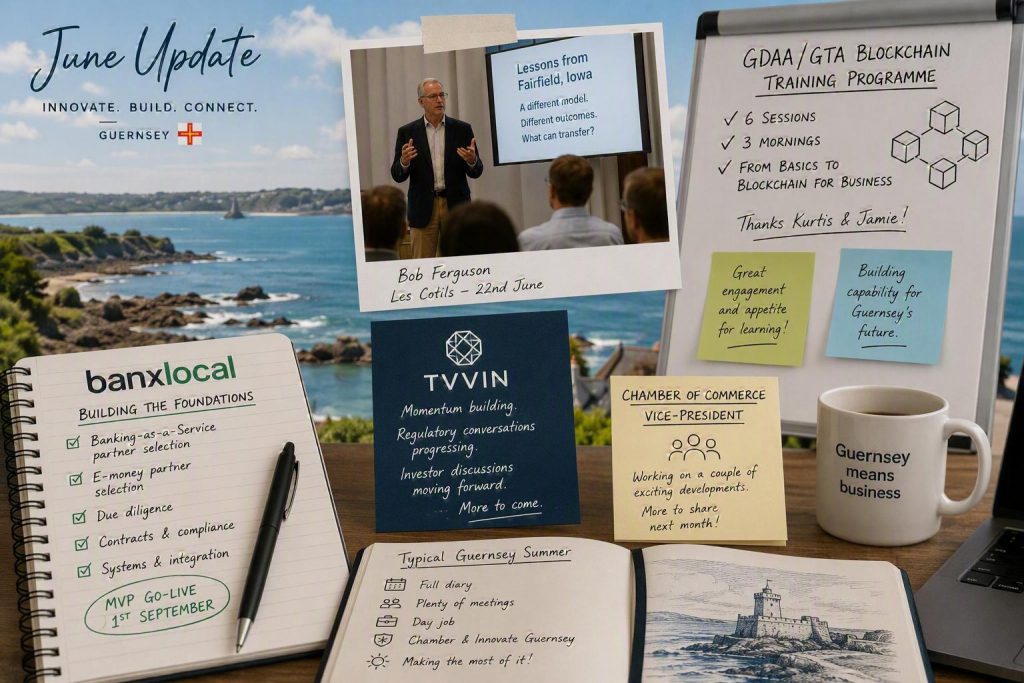
June was a good month for Innovate Guernsey. We hosted Bob Ferguson from Fairfield, Iowa at Les Cotils on 22nd June for a speaker session, always worth bringing in a perspective from somewhere with a completely different economic model and seeing what, if anything, transfers back to a jurisdiction our size. Alongside that, the GDAA/GTA blockchain training programme has been keeping me busy, six sessions across three mornings, working alongside Kurtis Wright and Jamie Winterburn to get people properly up to speed on the basics through to more advanced “blockchain for business” thinking. Encouraging to see the appetite for it.

On the banxlocal side, June and July have largely been about the unglamorous but essential groundwork, working through the detail of our banking-as-a-service and e-money partner selection. Not the kind of thing that makes headlines, but it’s exactly the sort of decision that determines whether everything downstream actually works when we go live. We’re targeting a Q4 2026 go-live for the MVP, so the next few weeks matter.

TVVIN continues to build momentum in the background too, with the regulatory and investor conversations progressing steadily. Work here has been centred on commercial partnerships and relationships across banks, financial institutions, back-office functions and developing and validating use cases for the stablecoins, more to share on all of that once there’s something more concrete to report.

Finally, I’ve been active since taking up my role as Vice-President at the Chamber of Commerce working on a couple of specific developments that I’ll be able to lift the lid on next month!

Otherwise, a fairly typical Guernsey summer — a full diary, plenty of meetings, and the usual mix of Chamber and Innovate Guernsey commitments alongside the day job. More soon.

Bitcoin Pizza Day.

On 22nd May 2010, Laszlo Hanyecz paid 10,000 BTC for two pizzas. At the time, it seemed like a quirky experiment. In retrospect, it was the first proof that a decentralised network could settle a real transaction between two parties who had never met, with no bank in the middle.

Most people tell that story as a punchline about expensive pizza. I think that misses what actually happened.

What Laszlo demonstrated, albeit clumsily, imperfectly, expensively, was that value could move across a network governed by mathematics rather than institutions. That the trust problem in payments could be solved without a trusted third party.

That idea has been working its way through the financial system ever since.

At TVVIN, we’re building regulated, asset-backed stablecoins, operating fully within the Guernsey financial framework and to be classified as fiat-equivalent instruments. No speculation. No volatility. Institutional-grade reserve management, with major banks holding the underlying assets.

But the rails we’re building on? They trace a direct line back to what Hanyecz proved possible in 2010.

The pizza wasn’t the point. The settlement was.

Fifteen years on, we’re at the stage where that primitive proof-of-concept has matured into infrastructure serious enough for institutional treasury, cross-border settlement, and the kind of programmable, compliant value transfer that actually changes how global finance works.

We’re not there because Bitcoin was a speculative asset. We’re there because it was a protocol.

Happy Pizza Day to everyone building the next layer.

#BitcoinPizzaDay #Stablecoins #TVVIN #DigitalFinance #Guernsey #BlockchainInfrastructure

Digital is coming

I’m building the infrastructure for it, the human face of it, and the safety net around the people living through it.

For a long time, I’ve talked about the things I’m building. I want to talk about why they’re the same thing.

Digital is coming. You can’t stop it any more than we stopped moving from gold sovereigns to paper money. The next evolution is digital currency — and it’s closer than most people think.

But here’s what keeps me up at night: we can’t leave people behind.

So, I’ve been working on three answers to that question:

🏗️ The rails — TVVIN (https://tvvin.com) is a GFSC regulation-pending stablecoin platform — the trusted infrastructure that makes digital currency something institutions can actually use. With significant institutional demand already demonstrated, this is real, and it’s happening.

🤝 The human face — banxlocal (https://banxlocal.uk) puts people back in the picture. Because when it comes to money, people want to walk into somewhere, talk to a real person, and feel like someone actually cares. Not a chatbot. Not a faceless app. Community financial hubs — the human face of a digital world.

🧠 The safety net — CoEfficient (https://coefficient-solutions.com) monitors and predicts mental health across workforces. Because change at this scale has a human cost. We need to measure it, manage it, and make sure no one falls through the cracks.

And sitting above all of it — my roles at Innovate Guernsey (https://innovateguernsey.com), the Guernsey Digital Assets Association, and the Guernsey Chamber of Commerce (https://guernseychamber.com) — shaping the environment where all of this can actually happen.

Reflections and forecasts…

Today would’ve been my father’s 94th birthday. I wonder what he’d have had to say about all the situations going on in the word right now. From former Prince Andrew and Lord Mandleson’s arrests to the wars and political turmoil almost everywhere I’m sure he’d have had a lot to say.

Looking ahead, the next few months look tough. Instability and uncertainty are never good things.

That all said, I’m inspired as we approach a new month because of a few reasons.

Firstly, my broken ankle is healing well and I’m back mobile again. Nothing like continual pain to bring you down, and now I’m pretty much pain free things inevitably seem a little brighter.

Secondly, the outlook for the projects I’m working with are encouraging. The outreach program for CoEfficient is going well, and the business is going to sweep into the UK market through the various channels we’ve opened up now. Alongside this, the engagement with the GFSC for TVVIN is going well and we are in full flow planning for operational launch. Then banxlocal.uk has also had encouraging signs for our funding requirements through the SEIS/EIS application process and should be in position to fully engage with angel investors very soon, and then the efforts of what is nearly 3 years of planning should start to yield results, culminating in that all important first branch opening.

Finally, the work I do through the Innovate Guernsey Board is really coming together, the team now have ‘taken over’ the oversight of the Digital Greenhouse and can now start to execute some of our plans. I have been working on a new and innovative mechanism to connect innovators and founders to service providers and advisers as well as a process for simplifying incorporation, governance and accessing investments.

The weather seems to have taken a turn for the better finally, after what has seemed to be a very long January and February. Looking forward to the spring arriving quickly now! (Also looking forward to the spring in my step returning too!)

Year end reflections…

We always seem to do this at this time of year, take a pause. reflect on the good and bad from the past year and how these experiences will shape the forthcoming year.

We must remember that time and the passing of time is a human construct, and so the real anniversaries are more around our accomplishments and achievements more than a linear marker in time such as New Years Day, birthdays or other anniversaries. Somehow though I always find myself ‘ahead of time’ and being pigeonholed as ‘too early’!

For some people an achievement that could be measured as a year’s worth of work can be compressed into a few weeks, whereas for others the same ‘output’ takes much longer. This doesn’t devalue the accomplishment and end product or output in my opinion, often the slower delivery builds better outcomes.

The last 3 years for me have been about building. With banxlocal.uk for example, we still build what will be the biggest shift in financial services delivery that the UK (and world) has seen, where access to banking is put, for the first time, into the hands of the customer. Has this tken longer than planned to deliver – hell yes! The world has taken such a long time to catch up with our vision – VC’s and Angel’s saying we’re too early, has hurt our progress, no doubt. 2026 though does finally feel like we will see our first branch(es) opened and the world finally awake to the incredible hole the service will plug for millions of people.

Back in 2022 I worked on a Digital Identity solution project, again this was too early and the world wasn’t ready, however, this topic, is going to be in 2026, a cornerstone of the digital assets space, and instrumental in the delivery of TVVIN – what started life as a tokenisation of precious metals project – that is now an entire ecosystem for transformation of stores of value/wealth, payments, banking and much more.

On a personal note, breaking my ankle and sustaining a head injury were low points in the year. My ankle won’t be ‘fixed until well into the new year, but I’m looking forward to 2026, and frankly I’m pleased to be saying goodbye to 2025!

Clocks Change, Markets Change: A Look at Crypto, Stablecoins, and Real-World Assets

In my last post, I wrote about the “wild weekend” that crypto experienced in October just before the clocks went back to GMT — a sharp and sudden drop in trading values for BTC and other cryptocurrencies that seemed also to signal that ‘Winter is Coming’! Since then, the situation hasn’t improved. At the time of writing, Bitcoin is hovering just below $90k, and market sentiment suggests further declines rather than recovery.

This reality has led many of us to question whether tokens or coins without any underlying value truly represent the future we once imagined.

Shifting Focus: Stablecoins and Real-World Assets

Over the past few weeks, my attention has shifted toward the stablecoin and real-world asset (RWA) space. In my view, this segment of blockchain technology is fundamentally different from the speculative world of crypto coins.

Fiat-backed stablecoins are gaining traction, with obvious use cases such as atomic cross-border payment rails. Meanwhile, RWA tokens are increasingly being used as a store of value, tracking traditional markets and asset classes that tend to be less volatile.

Guernsey’s Growing Interest

Guernsey’s evolving stance toward this space has sparked a wave of activity—meetings, dinners, and roundtable discussions focused on stablecoins and RWAs. These topics are now finding their way into broader business agendas across the island.

I was also pleased to attend the inaugural meeting of the Guernsey Blockchain Members Club (GMBC). The event brought together a diverse cross-section of the business community to discuss everything from the club’s founding principles to its potential role in shaping blockchain use cases for Guernsey’s benefit.

What’s Next?

I’ll share more details about the project I’m working on in a future post. The timing will likely coincide with the formal application for licensing to the GFSC.

The next phase of this project involves digital identity—a concept I explored back in 2021 when the world wasn’t quite ready for it. Today, with growing demand for atomic settlements, robust solutions for atomic KYC/AML are essential. After all, there’s little point in enabling instant programmable money if identity verification still takes days.

Watch this space for updates on all of the above. Exciting times ahead!

Crypto’s Wild Weekend: A Wake-Up Call for Human-Centric Innovation

This weekend’s crypto crash, triggered by President Trump’s surprise announcement of 100% tariffs on Chinese imports, was one of the most violent in the industry’s history. Between Friday night and Saturday morning (10th–11th October), over $19 billion in leveraged positions were liquidated, wiping out $560 billion in market value across Bitcoin, Ethereum, and countless altcoins. Bitcoin plunged from its recent all-time high of $126,000 to under $105,000 before recovering slightly. Ethereum, Solana, XRP, and Dogecoin saw similar or worse declines, with some altcoins briefly losing over 90% of their value.

This flash crash was not just a financial event—it was a stark reminder of how fragile and exclusionary our systems can be when they prioritize speculation over substance. Millions of traders were caught off guard, and many retail participants, especially those using high leverage—were left exposed. The speed and scale of the collapse revealed deep vulnerabilities in centralized exchanges, price oracles, and synthetic token markets.

In moments like these, I’m reminded why I work in this space, not to chase volatility, but to build technology that serves people.

At banxlocal.uk and through my broader ventures, I focus on human-centric blockchain solutions. That means designing systems that are inclusive, accessible, and grounded in real-world utility. Too often, financial and tech platforms are built for the few—those with capital, technical fluency, or physical ability to navigate complex interfaces. The rest are left behind.

I believe innovation must be empathetic. Whether it’s ensuring our platforms are usable by those with visual impairments or making tokenised equity offerings understandable to non-technical investors, the goal is always the same: build for everyone.

This weekend’s crash also underscores the importance of resilience. While markets may recover, the human cost, lost savings, shattered trust, and emotional stress, is harder to quantify. That’s why I advocate for transparent governance, education-first onboarding, and community-driven design in every blockchain product I touch.

Technology should empower, not intimidate. Finance should include, not exclude.

As we move forward from this turbulent moment, let’s not just rebuild the market. Let’s rebuild it better—with people at the centre.


A transformative week for digital innovation in Guernsey.

Last week marked the inaugural Digital Assets Conference (https://digitalconferenceguernsey.gg/), bringing together visionary speakers, dynamic panel discussions (including one which I had the pleasure of joining), and the event was capped off a spectacular Red Arrows display which we had the pleasure of viewing from the rooftop offices of Artemis Fiduciaries at Admiral Plaza. The energy and ambition in the conference were palpable – a clear signal that Guernsey is stepping confidently into the future of finance.

This week, the focus shifted further. I was part of a highly constructive session at the Guernsey Financial Services Commission, where the commitment and appetite to embracing blockchain and evolving our legacy financial services infrastructure was evident. The GFSC is making bold strides to ensure Guernsey remains relevant and competitive in the global financial landscape.

Looking ahead, we’re excited for Tekex#33 (https://www.tekex.co) on Thursday evening, which promises to be a great convergence of minds judging from recent events, with some excellent businesses being showcased.

The upcoming Chamber of Commerce (https://guernseychamber.com/) lunch on October 1st. Where I, alongside the other members of the Guernsey Innovation Board (https://innovateguernsey.com) will be sharing the roadmap for fostering an innovative ecosystem — and more importantly, to listen to feedback from the wider business community on where our collective focus should be. There’s still time to grab a ticket for this – available on the chamber website!

Guernsey is building momentum. It’s a privilege to be part of the journey.