
Stablecoins, Tokenised Deposits, and Why Guernsey Is Building a Third Way
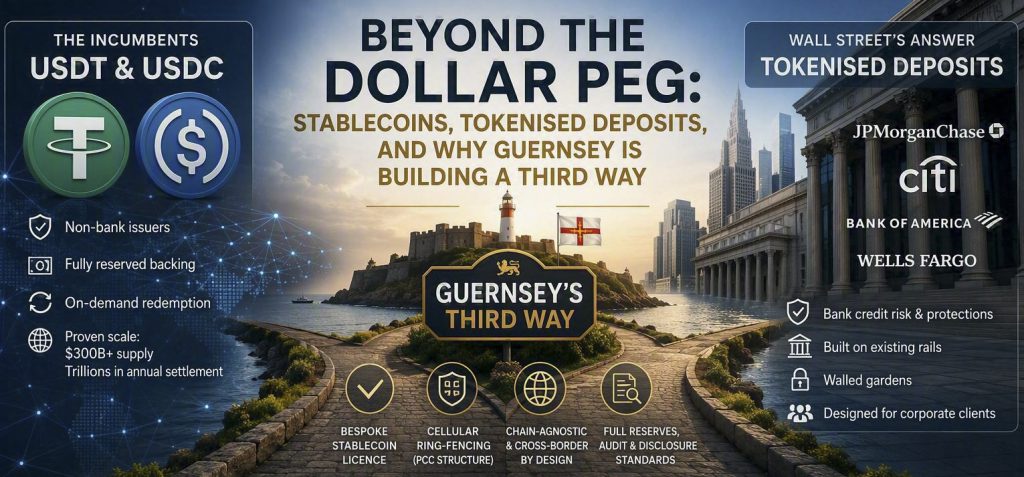
Stablecoins have quietly become one of the largest pieces of financial infrastructure to emerge from crypto markets, with total supply running somewhere north of $300 billion and two issuers, Tether’s USDT and Circle’s USDC, controlling roughly 85% of it between them. That dominance is now being challenged from two directions at once: Wall Street’s largest banks are building their own tokenised alternative, and a small number of well-regulated jurisdictions are proposing a structure that borrows the best of both worlds. Guernsey, and TVVIN specifically, sit in that third category, and the differences matter more than they might first appear.
The incumbents: USDT and USDC
Today’s stablecoin market is a study in concentration. USDT alone accounts for close to 60% of global supply, with USDC a distant second at around a quarter of the market, according to on-chain data aggregated by DefiLlama. Both are issued by non-bank companies that hold cash and short-dated government securities against every token in circulation, publish periodic attestations of those reserves, and allow holders to redeem on demand.
That model has proven itself at scale. Circulating supply has roughly doubled since 2024, and stablecoins now settle trillions of dollars a year in crypto trading, DeFi collateral and, increasingly, cross-border payments and remittances. Regulation is finally catching up: the US GENIUS Act’s implementation rules take full effect this month, requiring dollar stablecoin issuers to hold fully reserved, regularly audited backing, while the EU’s MiCA regime already classifies stablecoins as e-money or asset-referenced tokens issued only by authorised entities.
But the structural characteristics that built USDT and USDC’s scale are also their limitation. They are, ultimately, IOUs from a single non-bank company. Holders take on that issuer’s counterparty and reserve-management risk rather than a bank’s, and Tether’s continuing absence of a full independent audit being a frequently cited example, transparency standards still vary considerably between issuers.
Wall Street’s answer: tokenised deposits
The most direct competitive response has come from the banks themselves. In June, JPMorgan Chase, Citigroup, Bank of America and Wells Fargo confirmed plans, reported first by the Wall Street Journal, to build a shared tokenised deposit network through The Clearing House, the payments utility the banks jointly own, targeting a launch in the first half of 2027. Individually, several of them are already live: JPMorgan’s JPM Coin has operated on Coinbase’s Base network for institutional clients since late 2025, Citi Token Services already moves tokenised liquidity between New York, London and Hong Kong, and BNY launched its own institutional tokenised deposit product earlier this year. A separate consortium of regional US banks, the Cari Network, is targeting a retail-facing launch later in 2026.
The pitch is straightforward: a tokenised deposit is still a conventional bank deposit, same credit risk, same deposit protections, same accounting treatment, simply recorded on shared, programmable, always-on infrastructure instead of a bank’s internal ledger. For large corporate treasuries, that combination of blockchain-speed settlement with bank-grade protection is genuinely attractive, and it keeps deposit funding inside the regulated banking system rather than flowing out to non-bank stablecoin issuers.
It is also, by design, a walled garden. A tokenised deposit is a claim on one specific bank; it is not a bearer instrument that moves as freely between unrelated counterparties, chains and jurisdictions as a public stablecoin does. Even bank executives involved in the project have been candid that client demand, for now, is more anticipatory than urgent, Bank of America’s own head of global payments has said clients aren’t yet “beating down the door” for it.
The third path: Guernsey’s regulated stablecoin framework
This is the gap that smaller, more agile international finance centres are moving to fill, treating stablecoin issuance as neither an unregulated crypto product nor an extension of a single bank’s balance sheet, but as its own licensed financial activity.
The Guernsey Financial Services Commission has spent the past year building exactly that. Its Digital Finance Initiative consultation, launched in December 2025, proposes pulling stablecoins out of Guernsey’s existing virtual asset service provider regime entirely and regulating issuers instead as a distinct “financial firm business”, with rules that draw on both the US and Singapore approaches: full reserve backing in unencumbered, short-duration instruments, redemption within days, and ongoing capital, audit and disclosure requirements. Crucially, an Innovation Sandbox lets the Commission consider licence applications while the framework is still being finalised, rather than making applicants wait for a final rulebook.
Where TVVIN fits
TVVIN, where I serve as Co-Founder and COO, is one of the businesses building inside that emerging framework. It is structured as a Protected Cell Company, a Guernsey legal vehicle, more familiar from insurance and fund structures, that allows different stablecoin programmes to be ring-fenced from one another within a single licensed entity, rather than each requiring its own balance sheet and its own company. TVVIN’s licence application is progressing through the GFSC’s pathway under a fiat-equivalence classification, with PwC Guernsey engaged for software assurance, Moore Stephens for reserve attestation and Walkers as legal counsel, alongside banking relationships spanning multiple Guernsey banks and financial institutions.
That combination is the differentiation. Against USDT and USDC, TVVIN is built from the outset around a bespoke, purpose-designed stablecoin licence rather than a general virtual asset registration, with cellular ring-fencing that keeps risk in one programme from bleeding into another. Against bank tokenised deposits, it is not a claim on a single bank’s balance sheet, it is designed to be chain-agnostic and cross-border by construction, launching on Ethereum with expansion planned across further networks based on demand, in the same way public stablecoins already move freely between wallets, exchanges and jurisdictions.
There is also a product dimension worth noting. Of the several hundred stablecoins currently tracked across public chains, effectively all of them are pegged to the US dollar. TVVIN’s roadmap deliberately looks beyond that, including work on commodity-backed tokens referencing gold and silver, and early-stage exploration of non-dollar currency stablecoins, a bet that the next phase of stablecoin growth won’t simply be more dollars on more chains, but a genuinely broader set of regulated, redeemable digital assets.
Institutional appetite for that combination is already showing up in the numbers: TVVIN has attracted indicative institutional pre-orders in excess of £100 million ahead of licensing, a signal that treasury allocators are actively looking for regulated alternatives that sit outside both the large offshore issuers and the big US banks’ tokenised deposit plans.
The bigger picture
None of this means USDT, USDC or bank tokenised deposits are going away, each is solving a real problem for a real set of users, and all three models will likely coexist. But the next phase of stablecoin adoption looks less like a two-horse race between Tether and Circle, and more like a three-way split between globally dominant non-bank issuers, bank-owned tokenised deposit networks built for existing corporate clients, and purpose-licensed regulated issuers built in jurisdictions like Guernsey specifically to sit between the two. TVVIN is being built for that third lane.